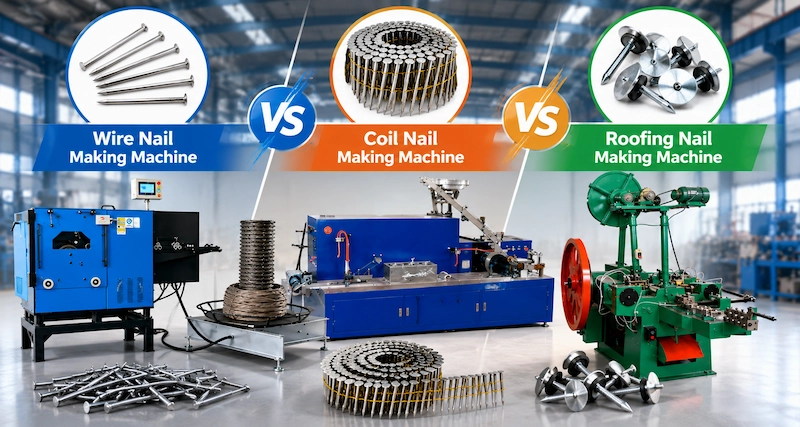
Choosing the right nail making machine is not simply a matter of production capacity. The decision should be based on the type of nails you plan to manufacture, your target market, investment budget, and long-term business goals.
For manufacturers supplying construction, packaging, furniture, pallet, or roofing industries, selecting between a wire nail making machine, coil nail production line, and roofing nail making machine can significantly impact profitability and operational efficiency. Each machine serves a different market segment and requires different levels of investment, automation, and technical support.
This guide compares the three options from a practical business perspective to help buyers determine which solution best matches their production requirements.
A wire nail making machine is designed to produce traditional straight nails from steel wire. These nails are widely used in construction, woodworking, furniture manufacturing, pallet production, and general industrial applications.
The machine automatically performs wire feeding, cutting, head forming, and nail pointing.
Common products include:
Common nails
Concrete nails
Finishing nails
Box nails
Woodworking nails
Industrial fastening nails
For manufacturers entering the nail production industry, a steel wire nail making machine is often the most cost-effective starting point.
A coil nail production line consists of multiple machines working together to manufacture collated nails arranged in coils.
The process typically includes:
Nail making
Polishing
Sorting
Coil welding or plastic collation
Packaging
The finished coil nails are primarily used in pneumatic nail guns for:
Pallet manufacturing
Wooden packaging production
Prefabricated construction
Furniture assembly
Export packaging industries
Compared with ordinary nail production, coil nail manufacturing offers higher value-added products and stronger demand from industrial users.
Roofing nail making machines are specifically designed to produce nails with large heads used for roofing and waterproofing applications.
Typical products include:
Roofing nails
Umbrella head roofing nails
Cap nails
Felt nails
Waterproof membrane nails
These nails are commonly used in:
Residential construction
Asphalt shingle installation
Roofing insulation systems
Waterproofing projects
Because of their specialized design, roofing nails usually command higher selling prices than standard wire nails.
| Factor | Wire Nail Machine | Coil Nail Machine | Roofing Nail Machine |
Product Type | Straight nails | Collated coil nails | Large-head roofing nails |
Initial Investment | Low | High | Medium |
Production Complexity | Simple | Complex | Medium |
Market Demand | Stable | High-growth industrial sector | Construction-focused |
Profit Margin | Moderate | High | Moderate to High |
Automation Level | Medium | High | |
Additional Equipment Needed | Limited | Multiple auxiliary machines | Limited |
Ideal Buyer | New investors | Large-scale manufacturers | Construction supply producers |
For most first-time investors, a wire nail making machine offers the lowest entry barrier.
Typical production setups require:
Nail making machine
Wire drawing machine
Nail polishing machine
Advantages include:
Lower equipment costs
Easier operation
Faster installation
Lower maintenance expenses
Smaller factory footprint
Many entrepreneurs looking for a nail making machine for sale begin with standard nail production because demand exists in almost every construction market worldwide.
In many markets, coil nail production generates the highest profit margins.
The reason is simple:
Coil nails are consumed by industrial users rather than individual construction workers. Customers often purchase large volumes for continuous manufacturing operations.
Examples include:
Pallet factories
Export packaging companies
Furniture manufacturers
Prefabricated housing producers
Because coil nails work with pneumatic nail guns, customers prioritize consistency, quality, and reliable supply over simply finding the lowest price.
However, higher profitability comes with:
Greater equipment investment
More complex production management
Higher quality requirements
Additional maintenance responsibilities
For companies with established sales channels, coil nail production can deliver attractive long-term returns.
The answer depends largely on your local construction market.
Roofing nails remain essential products in regions where:
Asphalt shingles are common
Residential construction is active
Waterproof roofing systems are widely used
Building renovation projects are frequent
Countries with strong roofing nail demand often include:
United States
Canada
Mexico
Parts of Europe
Middle Eastern construction markets
Manufacturers targeting these sectors may benefit from adding roofing nail production because competition is often lower than in the standard wire nail market.
Production capacity should be matched to your expected sales volume.
Recommended capacity:
150–350 nails per minute
Suitable for:
Local distributors
Regional construction suppliers
New manufacturing businesses
Recommended capacity:
400–800 nails per minute
Suitable for:
Export-oriented factories
Industrial fastener suppliers
Large construction material distributors
Recommended capacity:
800+ nails per minute
Multiple production lines
Suitable for:
International exporters
OEM manufacturers
Large-volume industrial suppliers
Purchasing excessive capacity too early often increases operating costs without improving profitability.
The most common raw materials include:
Low carbon steel wire
Medium carbon steel wire
High carbon steel wire
Galvanized steel wire
Stainless steel wire
Corrosion-resistant coated wire
Bright steel wire
Electro-galvanized wire
Hot-dip galvanized wire
Raw material availability should be considered before purchasing equipment, especially for export-oriented production.
Ask yourself:
Are your customers construction companies?
Pallet manufacturers?
Packaging factories?
Building material distributors?
The answer will often determine the most suitable machine.
Higher automation generally means:
Reduced labor costs
Improved consistency
Higher production output
But it also means:
Higher capital investment
More technical training
Machine uptime directly affects profitability.
Before purchasing, confirm:
Spare parts availability
Technical support response time
Remote troubleshooting services
Installation assistance
Many successful manufacturers begin with a steel wire nail making machine and later expand into:
Coil nail production
Roofing nail production
Specialty fasteners
Selecting equipment that supports future upgrades can reduce long-term costs.
The best choice depends on your business model rather than the machine itself.
Choose a Wire Nail Making Machine If:
You are entering the nail manufacturing industry.
You want lower startup costs.
You need stable demand and simpler production.
Choose a Coil Nail Production Line If:
You supply industrial customers.
You want higher-value products.
You can invest in advanced automation.
Choose a Roofing Nail Making Machine If:
Your market has strong roofing demand.
You serve construction material distributors.
You want to specialize in a less competitive product segment.
For many growing manufacturers, starting with a wire nail making machine and expanding into coil or roofing nail production later provides the best balance between investment risk and long-term profitability.
Coil nails generally offer the highest profit potential due to their industrial applications and higher selling prices.
Yes. Most modern nail making machines can produce multiple nail sizes through mold and tooling changes within their specified range.
A standard wire nail production line may require approximately 100–300 square meters, while a complete coil nail production line usually requires significantly more space.
Payback periods vary depending on local labor costs, raw material prices, and sales volume. Many manufacturers target a return period of one to three years under stable operating conditions.
Yes. Construction, furniture manufacturing, pallet production, packaging, and infrastructure development continue to drive global demand for wire nails, roofing nails, and coil nails.
 English