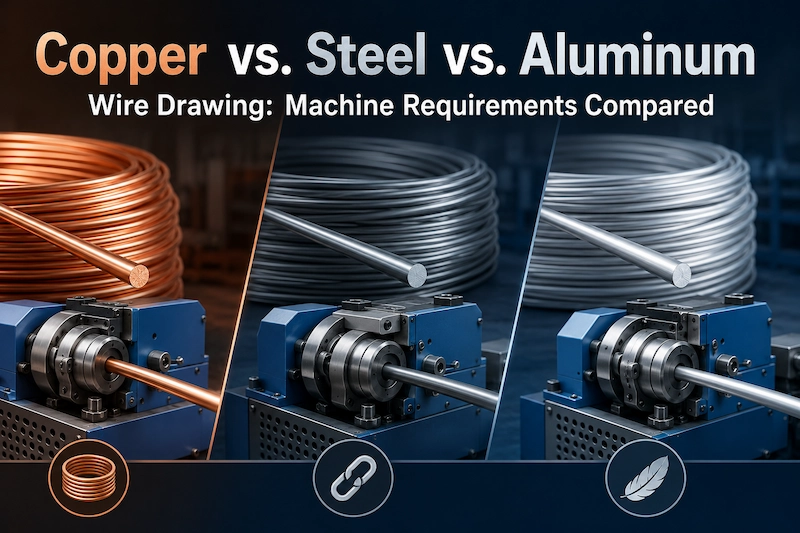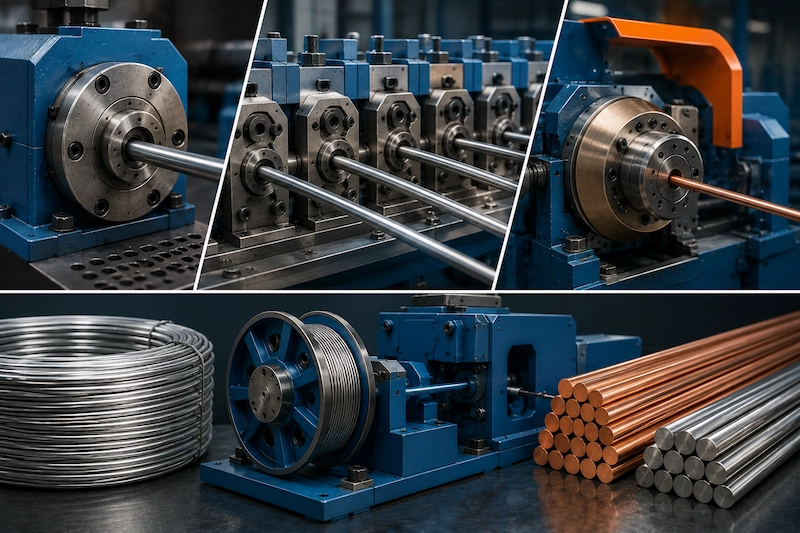
Choosing between dry wire drawing and wet wire drawing is not simply a technical decision—it directly affects production efficiency, wire quality, maintenance costs, factory layout, and long-term profitability.
In general, dry wire drawing is better suited for medium and large-diameter wire production with lower operating complexity and maintenance costs, while wet wire drawing is often preferred for fine wire manufacturing where surface finish, precision, and high-speed production are critical.
The right solution depends on your finished wire specifications, raw material type, production volume, downstream applications, and investment budget. Understanding the trade-offs between the two processes can help manufacturers avoid costly equipment mismatches.
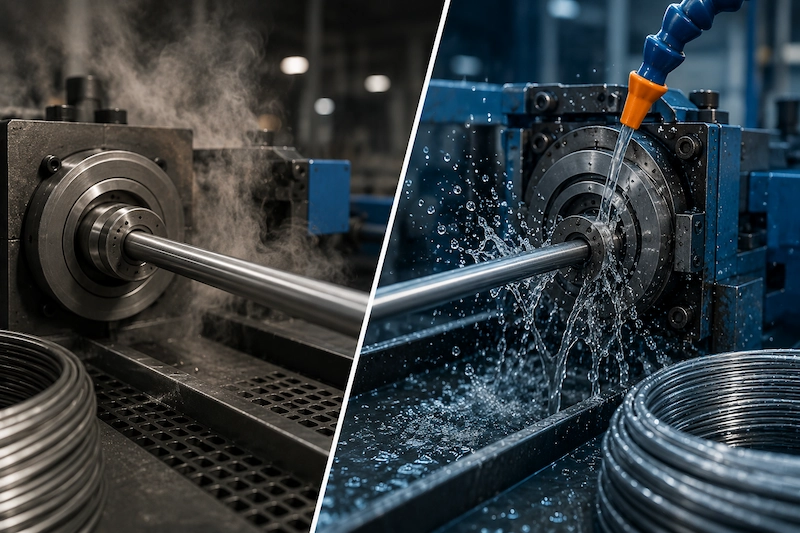
Both processes reduce wire diameter by pulling metal wire through a series of dies, but the main difference lies in the lubrication and cooling method.
In dry wire drawing, the wire passes through a dry lubricant (typically powdered soap or coating compounds) before entering the die.
The lubricant reduces friction during deformation while minimizing equipment complexity.
Dry drawing is commonly used for:
Nail wire production
Steel wire rope wire
Mesh wire
Binding wire
Galvanized wire preparation
Construction wire products
Most factories producing nails, wire mesh, or fencing products use a dry-type wire drawing machine because of its practicality and relatively lower operating cost.
Wet wire drawing uses liquid lubricants or emulsions to cool and lubricate the wire continuously during processing.
The wire typically runs through submerged lubrication systems that reduce heat buildup and improve surface quality.
Wet drawing is commonly used for:
Fine steel wire
Stainless steel wire
Copper wire
Aluminum wire
Welding wire
Precision industrial wire
Because of better cooling efficiency, wet drawing generally supports smaller wire diameters and higher line speeds.
| Factor | Dry Wire Drawing | Wet Wire Drawing |
Lubrication | Dry powder lubricant | Liquid lubricant/emulsion |
Cooling Efficiency | Moderate | Excellent |
Surface Finish | Standard | Superior |
Suitable Wire Diameter | Medium to large | Fine and ultra-fine |
Equipment Complexity | Lower | Higher |
Maintenance Difficulty | Easier | More demanding |
Initial Investment | Lower | Higher |
Operating Speed | Moderate | High |
Factory Cleanliness | Dust generation | Cleaner but liquid management required |
Best for | Nails, mesh, wire rope | Precision wire production |
For nail factories and construction wire manufacturers, dry wire drawing is usually the more practical option.
Why?
Because products such as:
Common nails
Barbed wire
Wire mesh
Binding wire
Galvanized steel wire
typically require medium carbon or low carbon steel wire with moderate dimensional tolerances.
Dry drawing offers several advantages:
Dry systems generally consume less energy and require fewer liquid treatment systems.
This helps reduce:
Lubrication expenses
Waste disposal costs
Water treatment requirements
Daily maintenance labor
For factories producing high volumes of steel wire for nail making, dry drawing often delivers stronger ROI.
A dry-type wire drawing machine contains fewer fluid management components.
This reduces the risk of:
Coolant contamination
Leakage
Pump failure
Lubrication circulation problems
Maintenance teams can usually service dry systems faster.
Many nail manufacturers integrate wire drawing directly with nail production lines.
Dry drawing is often preferred because the wire can move more efficiently into downstream nail-making operations without additional drying processes.
Wet wire drawing becomes more attractive when product quality requirements become stricter.
Factories producing fine-diameter wire often prioritize:
Surface smoothness
Diameter consistency
Mechanical precision
High-speed continuous production
Liquid lubrication reduces friction more effectively than dry compounds.
This often results in:
Smoother wire surfaces
Fewer scratches
Better coating adhesion
Improved downstream processing
For products such as welding wire or precision industrial wire, surface defects can become costly.
High-speed wire drawing generates substantial heat.
Excessive heat may cause:
Wire breakage
Surface damage
Die wear
Inconsistent tensile strength
Wet drawing minimizes thermal stress and improves production stability.
Wet systems often operate faster, especially for fine wire applications.
Factories focused on mass production of small-diameter wire may recover the higher investment cost through productivity gains.
One of the most important buying considerations is finished wire diameter.
Medium and thick wire diameters
Typical range:
1.5 mm – 8 mm+
Nail wire
Mesh wire
Construction wire
Fine and ultra-fine wire
Typical range:
Below 1.5 mm
Stainless precision wire
Electrical wire
Welding wire
Selecting the wrong process for your target diameter can reduce productivity and increase material waste.
The answer depends on production goals.
Dry systems usually require:
Lower capital investment
Simpler infrastructure
Fewer consumables
Less technical expertise
This makes them attractive for:
Small factories
Growing manufacturers
Nail production businesses
Emerging market operations
Wet systems generally involve:
Coolant systems
Filtration equipment
Pumps
Fluid treatment
Although operating complexity increases, manufacturers producing premium wire products often justify the investment through higher product value.
Maintenance is often overlooked during machine selection.
Common issues include:
Lubrication powder buildup
Dust accumulation
Die wear
Feeding inconsistency
Preventive cleaning is essential to maintain stable performance.
Common concerns include:
Coolant contamination
Liquid leakage
Pump failures
Corrosion risks
Waste fluid management
Factories without proper maintenance systems may struggle with unexpected downtime.
Before purchasing equipment, factory owners should evaluate several practical questions.
If your main products include:
Nails
Wire mesh
Fencing products
Steel binding wire
Dry wire drawing is usually the better fit.
If your products include:
Fine industrial wire
Precision welding wire
Stainless steel wire
Wet drawing may deliver better performance.
Small and medium factories often benefit from simpler systems with lower maintenance demands.
Larger operations with technical teams may gain more from high-speed wet drawing equipment.
Wet systems can reduce scrap and improve quality, but they usually require more technical oversight.
In regions with higher labor costs, automation benefits may outweigh the additional investment.
Some manufacturers begin with dry drawing for standard products and later add wet drawing lines for premium applications.
Expansion flexibility can improve long-term competitiveness.
There is no universal answer because production goals differ.
Choose Dry Wire Drawing If:
You manufacture nails or construction wire.
You want lower investment costs.
You prioritize simple maintenance.
You process medium or larger wire diameters.
Choose Wet Wire Drawing If:
You manufacture precision or fine wire.
Surface quality is critical.
You require higher production speed.
You target premium-value products.
For many nail and wire product manufacturers, a dry-type wire drawing machine remains the most practical and commercially efficient solution. However, factories focused on precision wire applications may gain stronger long-term value from wet drawing systems despite higher initial costs.
In most cases, yes. Dry systems usually involve lower equipment, maintenance, and operating costs.
Yes. Wet drawing generally produces smoother surfaces and more consistent dimensions, especially for fine wire.
Dry wire drawing is typically preferred because it works well with medium-diameter steel wire and integrates efficiently with nail production lines.
Usually yes. Coolant systems, pumps, and fluid treatment increase maintenance requirements.
The best choice depends on wire diameter, production volume, product requirements, maintenance capability, and long-term business goals.
 English