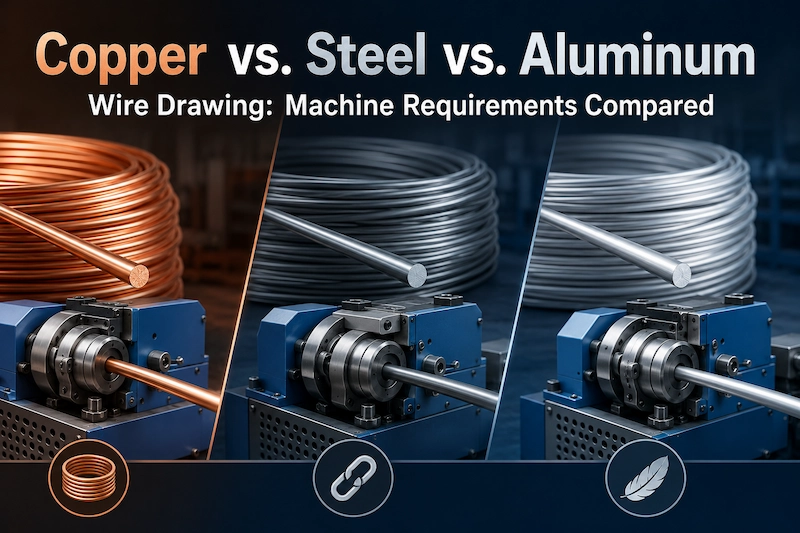
Selecting the right Wire Drawing Machine is one of the most important decisions for wire manufacturers because it directly affects production speed, wire quality, operating costs, labor requirements, and long-term profitability.
Different machine types are designed for different production goals. A single die machine may be ideal for flexible, low-volume production, while a multi-die system suits continuous high-output manufacturing. Inverted wire drawing machines are often chosen for heavy-duty wire and large coil applications.
The best option depends on your wire material, target diameter, production capacity, automation requirements, and downstream products such as nails, mesh, steel rope, welding wire, or galvanized wire.
This guide explains the major types of wire drawing equipment, their differences, advantages, limitations, and how to determine which system best fits your factory.
A wire drawing machine reduces the diameter of metal wire by pulling it through one or more drawing dies.
The process improves:
Dimensional accuracy
Surface finish
Tensile strength
Production consistency
Wire drawing machines are widely used for:
Nail production
Wire mesh manufacturing
Steel wire rope
Galvanized wire
Welding wire
Spring wire
Fastener manufacturing
However, not all machines are built for the same production environment.
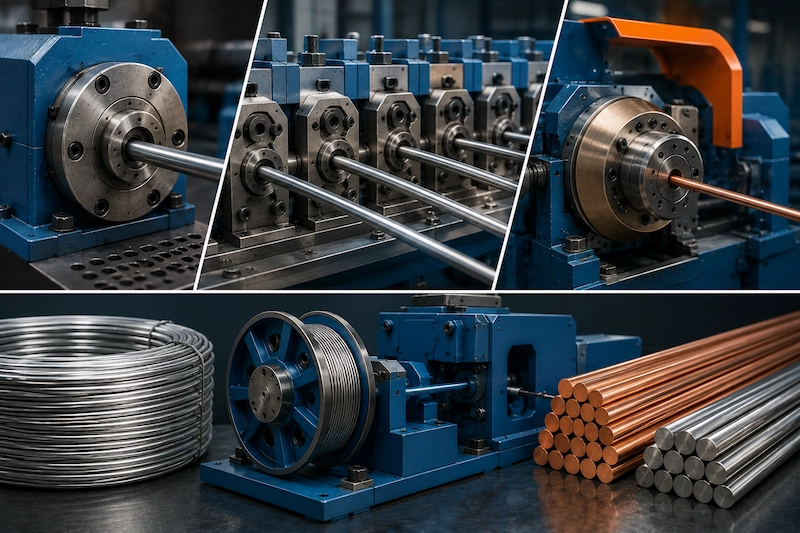
The most common wire drawing machine types include:
Single Die Wire Drawing Machine
Multi-Die Wire Drawing Machine
Inverted Vertical Wire Drawing Machine
Straight Line Wire Drawing Machine
Water Tank (Wet Type) Wire Drawing Machine
Pulley Wire Drawing Machine
Each machine type solves different production challenges.
A single die wire drawing machine reduces wire diameter through one die at a time.
The wire may pass through multiple cycles manually or semi-automatically to reach the required size.
Small-scale production
Flexible manufacturing
Multiple product sizes
Small batch orders
Specialty wire processing
Lower equipment investment
Simple structure
Easy maintenance
Lower technical requirements
Flexible diameter adjustments
Lower production speed
Higher labor involvement
Reduced efficiency for large-scale production
Nail factories
Small wire workshops
Repair and reprocessing operations
Custom wire manufacturing
For smaller factories or businesses entering the market, single die systems are often the most affordable starting point.
A multi-die wire drawing machine pulls wire continuously through multiple dies in sequence.
Each die progressively reduces the wire diameter until the target specification is achieved.
Continuous production
High-volume factories
Standardized wire products
Export-oriented manufacturing
High production speed
Better consistency
Reduced labor requirements
Improved automation
Lower unit production cost
Higher upfront investment
More complex maintenance
Less flexibility for frequent size changes
Nail manufacturing lines
Wire mesh production
Galvanized wire factories
Steel wire rope production
For factories running high-volume operations, multi-die systems usually offer stronger long-term ROI despite the higher initial cost.
An inverted wire drawing machine (also called an upside-down wire drawing machine) is specifically designed for larger-diameter wire and heavy wire coils.
The wire coil rotates while the machine draws the wire downward.
This design improves tension stability and handling for large wire sizes.
High-carbon steel wire
Large-diameter wire
Heavy steel coils
Tire cord wire
Prestressed concrete wire
Handles large wire coils efficiently
Better tension control
Lower wire twisting risk
Suitable for heavy-duty applications
Higher equipment cost
Larger installation space
Greater infrastructure requirements
Construction wire
Steel cable wire
Prestressed steel wire
Heavy industrial wire production
Factories processing thick wire often find inverted systems more stable than traditional horizontal machines.
Straight line wire drawing machines use independent motors for each capstan and maintain constant wire tension throughout production.
They are among the most advanced systems available.
High-speed production
Precision wire manufacturing
Automated factories
Premium wire products
Excellent wire quality consistency
Stable tension control
Higher automation
Reduced wire breakage
Better energy efficiency
Higher capital investment
More advanced maintenance requirements
Precision steel wire
Industrial wire manufacturing
Export-quality wire production
Many modern factories upgrading automation choose straight line systems to improve product consistency and reduce labor costs.
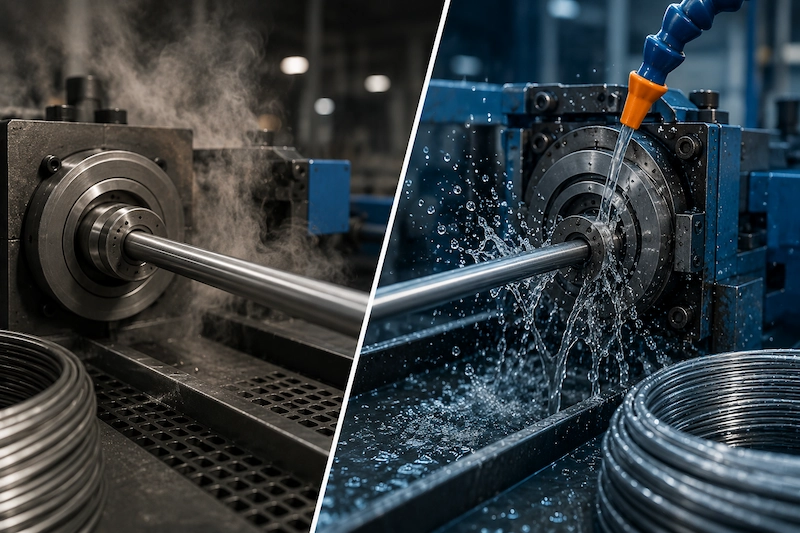
Wet drawing machines use liquid lubrication to reduce friction and heat during processing.
The wire passes through lubricant-filled systems for smoother drawing.
Fine wire production
Small wire diameters
Precision applications
Better surface finish
Improved cooling
Reduced die wear
Higher drawing speed
More maintenance
Coolant management required
Higher operating complexity
Stainless steel wire
Fine steel wire
Copper wire
Welding wire
Factories focused on fine-diameter wire often prefer wet drawing due to better surface quality.
Pulley wire drawing machines transfer wire between multiple pulley-driven drums.
They remain common in many steel wire factories because of their practicality and lower cost.
Medium wire diameter production
General industrial wire manufacturing
Cost-effective
Durable structure
Easy operation
Reliable production
Lower automation compared with straight-line systems
Reduced precision at very high speeds
Nail wire
Mesh wire
Construction wire
Steel fencing products
| Machine Type | Investment | Speed | Flexibility | Best For |
Single Die | Low | Low | High | Small factories |
Multi-Die | Medium–High | High | Medium | Mass production |
Inverted | High | Medium–High | Medium | Heavy wire |
Straight Line | High | High | Medium | Precision manufacturing |
Wet Type | Medium–High | High | Low | Fine wire |
Pulley Type | Medium | Medium | Medium | General production |
For nail production factories, machine selection depends on output volume.
Recommended:
Single die or pulley wire drawing machine
Why?
Lower startup investment
Easier maintenance
Flexible wire size adjustment
Recommended:
Multi-die or straight line wire drawing machine
Why?
Higher production speed
Better wire consistency
Lower labor cost per ton
For factories operating continuous nail production lines, production stability often outweighs initial machine price.
Ask yourself:
What is your target output per day?
Will production expand in the next 3–5 years?
Overbuying equipment increases costs, while undersized equipment limits growth.
Different machines handle different wire sizes.
Always confirm:
Input wire diameter
Final wire diameter
Material hardness
Downtime can become costly.
Evaluate:
Spare parts availability
Technical support
Operator training
Ease of repairs
Some systems—especially inverted and multi-die machines—require larger installation areas and reinforced foundations.
Logistics planning before purchase helps avoid expensive factory modifications later.
The best choice depends on production priorities.
Choose a Single Die Machine If:
You need flexibility.
Production volume is smaller.
Budget is limited.
Choose a Multi-Die Machine If:
You need high-volume production.
Product specifications are standardized.
Labor efficiency matters.
Choose an Inverted Machine If:
You process heavy or thick wire.
Coil handling is a challenge.
Choose a Straight Line Machine If:
You prioritize automation.
Product consistency is critical.
Choose a Wet Drawing Machine If:
You manufacture fine or precision wire.
Choose a Pulley Machine If:
You want balanced cost and performance for general wire manufacturing.
The right Wire Drawing Machine should support not only your current production needs but also future expansion plans, labor efficiency goals, and product quality expectations.
Multi-die and pulley wire drawing machines are among the most commonly used systems in industrial steel wire production.
Pulley, single die, and multi-die systems are commonly used depending on factory size and output requirements.
For heavy wire and large coils, the improved tension control and handling efficiency often justify the investment.
Wet drawing uses liquid lubricants for fine wire and better cooling, while dry drawing uses powder lubrication and is more common for nail and construction wire.
Evaluate machine durability, spare parts availability, after-sales support, technical training, and long-term operating costs rather than focusing only on price.
 English