Pencil erasers are one of the most commonly used stationery products in the world. Every school, office, and art studio consumes them in huge quantities every year. Although they look small and simple, modern erasers are actually produced using advanced automated machinery designed for high efficiency and consistent quality.
So what exactly is needed to make a pencil eraser today? In this guide, we will explain the raw materials, the production process, and the core equipment behind modern eraser manufacturing — especially the role of the pencil eraser making machine.
In the past, erasers were mainly made from natural rubber through labor-intensive processes. However, with the rapid growth of the global stationery market, manufacturers now require faster production speeds, stable product quality, and lower labor costs.
This is where modern pencil eraser making machines play a crucial role. These fully automated production systems allow manufacturers to produce thousands of erasers every hour while maintaining precise shape, color consistency, and durability.
Whether you are planning to start a stationery production line or expand an existing factory, understanding how modern erasers are made is the first step toward choosing the right equipment.
One of the most common questions from overseas buyers is: What materials are actually used to make pencil erasers today?
Modern erasers are no longer made mainly from natural rubber. Instead, most manufacturers use:
PVC (Polyvinyl Chloride) granules
TPR (Thermoplastic Rubber) pellets
Color masterbatch (pigments)
Softening agents and stabilizers (depending on product quality level)
These materials offer several advantages over traditional rubber:
More stable quality
Better elasticity
Stronger durability
Easier color customization
More suitable for high-speed automated production
For buyers who are new to eraser production, material sourcing can be a challenge. In addition to providing pencil eraser making machines, we also supply different grades of PVC and TPR raw materials, helping overseas customers build a complete production solution without needing multiple suppliers.
A modern eraser production line is highly automated. The entire process — from raw material feeding to final cutting — is completed by one integrated machine system.
Here is how a typical pencil eraser making machine works step by step.
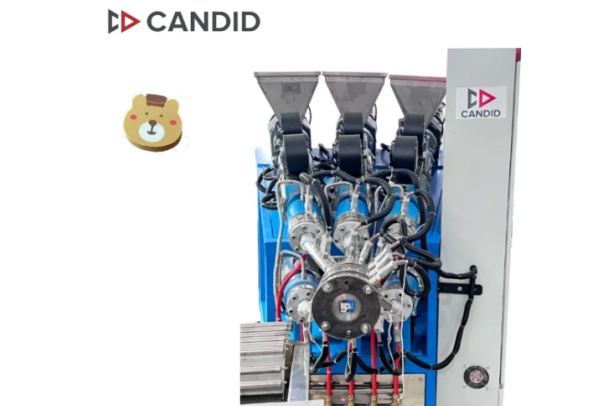
The process starts by pouring dried PVC or TPR granules into the hopper. Inside the machine, a single-screw extruder begins to rotate and push the material forward.
High-quality machines are equipped with four heating zones, each using cast-aluminum heating rings combined with insulation covers. Together with a precise temperature control system, this ensures the raw material melts evenly without burning or losing elasticity.
Stable melting is one of the most important factors that determine the final quality of the eraser.
After melting, the material is pushed through a specially designed mold. This process forms a continuous eraser strip that can be:
Single-color
Dual-color
Multi-color
Standard pencil eraser shape
Custom cartoon or creative shapes
Modern pencil eraser making machines allow manufacturers to easily switch molds, making it possible to produce different product styles using the same equipment.
The newly extruded eraser strip is still very hot and soft, so it must be cooled quickly to keep its shape.
The strip passes through a cooling system that combines water cooling and air cooling, allowing the eraser to solidify rapidly while maintaining smooth surfaces and consistent dimensions.
Proper cooling also improves product durability and prevents deformation during storage or packaging.
Once the eraser strip is fully cooled, it moves into the automatic cutting system. The machine cuts the strip into uniform pieces based on the preset size.
After cutting, the finished erasers can directly enter the next production steps, such as:
Heat transfer printing
Logo printing
Packaging
Box packing
This fully automated workflow significantly reduces manual labor and increases production efficiency.
For stationery manufacturers, choosing the right equipment is not just about production — it is about long-term stability, efficiency, and product quality.
A fully automatic pencil eraser making machine offers several key advantages.
Modern machines can achieve high output levels, making them ideal for factories targeting large-volume orders from schools, wholesalers, and stationery brands.
High production efficiency also means lower unit cost and faster return on investment.
High-quality eraser making machines are built with industrial-grade components designed for long-term operation. Stable temperature control, durable extruder systems, and reliable electrical components ensure the machine runs smoothly even during long production shifts.
This reliability is especially important for overseas buyers who need equipment that works consistently with minimal maintenance.
Different markets require different types of erasers. Some customers prefer standard pencil erasers, while others focus on colorful or creative designs.
A fully automatic pencil eraser making machine can be customized to produce:
Single-color erasers
Multi-color erasers
Cartoon erasers
Promotional erasers
School-grade and premium-grade products
This flexibility allows manufacturers to adapt quickly to changing market trends.
Although a pencil eraser is a small product, manufacturing it efficiently requires the right materials, the right process, and most importantly, the right machine.
A modern pencil eraser making machine not only improves productivity but also ensures consistent product quality, lower labor costs, and long-term business growth.
If you are planning to start an eraser production line or upgrade your existing factory, choosing a reliable machine supplier is the key first step.
 English