An automatic wire drawing machine reduces the diameter of metal wire by repeatedly pulling it through a series of drawing dies while improving dimensional accuracy, surface quality, and mechanical properties. Compared with traditional wire drawing equipment, an automatic wire drawing machine integrates automated feeding, tension control, lubrication, monitoring, and take-up systems to achieve higher productivity and more stable steel wire drawing performance.
For manufacturers producing steel wire, welding wire, nail wire, spring wire, galvanized wire, and other metal products, selecting the right wire drawing machine is critical for improving production efficiency, reducing material waste, and maintaining consistent wire quality.
A wire drawing machine is industrial equipment used to reduce the diameter of metal wire by pulling it through specially designed drawing dies. During the drawing process, the wire diameter decreases while its length increases, and the material structure is modified through controlled deformation.
The basic working principle includes:
Feeding the raw wire into the machine
Passing the wire through a series of drawing dies
Applying controlled pulling force through capstans or blocks
Cooling and lubricating the wire during deformation
Collecting the finished wire through a take-up system
An automatic wire drawing machine performs these steps continuously with minimal manual intervention, allowing manufacturers to achieve higher output and consistent product specifications.
An automatic wire drawing machine uses multiple mechanical and electrical systems to control the complete drawing operation.
The feeding system delivers raw wire smoothly into the drawing section. Stable feeding is essential because uneven wire supply can cause:
Wire breakage
Surface defects
Uneven diameter reduction
Production interruptions
Modern machines often use automatic feeding devices and tension control systems to maintain consistent material flow.
The drawing die is the core component of the wire drawing process.
As the wire passes through each die, its diameter is gradually reduced. Multi-pass drawing systems use several dies with different diameters to achieve the required final size without excessive stress on the wire.
The quality of drawing dies directly affects:
Wire surface finish
Diameter accuracy
Tool lifespan
Production efficiency
The capstan system generates the pulling force required to move wire through the dies.
In automatic wire drawing machines, variable-speed drives and precise tension control help maintain stable drawing conditions, especially when processing high-strength steel wire.
During steel wire drawing, friction between the wire and drawing dies generates heat.
Effective lubrication and cooling systems help:
Reduce friction
Prevent wire surface damage
Extend die life
Improve production stability
Different materials and wire sizes require different lubrication methods, including dry drawing and wet drawing processes.
After drawing, the finished wire is collected automatically onto spools, coils, or reels.
Automatic take-up improves:
Production continuity
Labor efficiency
Coil consistency
Handling safety
Automatic wire drawing machines are classified according to production method, material requirements, and application.
A straight line wire drawing machine passes wire through multiple drawing blocks arranged in sequence.
Advantages include:
High production speed
Stable wire quality
Suitable for large-scale manufacturing
Efficient continuous operation
This type is widely used for producing steel wire, welding wire, and industrial wire products.
A spool type machine collects drawn wire directly onto spools.
It is suitable for:
Fine wire production
Precision wire applications
Smaller diameter wire processing
This design provides better control over finished wire handling.
Wet drawing machines use liquid lubricant during the drawing process.
Benefits include:
Better cooling performance
Improved surface quality
Reduced die wear
Wet drawing is commonly used when producing fine steel wire requiring excellent surface finish.
Dry drawing uses solid lubricants such as powder lubricants.
It is commonly applied to:
Medium and large diameter steel wire
Construction wire
General industrial wire products
Dry drawing equipment is known for simpler operation and easier maintenance.
A multi-pass machine completes several drawing operations in one continuous production line.
It provides:
Higher efficiency
Reduced manual handling
Better dimensional consistency
This type is preferred by factories requiring high-volume steel wire drawing production.
Steel wire drawing is a metal forming process that changes the diameter and properties of steel wire through controlled deformation.
The complete process usually includes the following stages:
Before drawing, raw steel wire may require cleaning to remove:
Rust
Scale
Oil contamination
Surface impurities
Proper surface preparation improves lubrication performance and reduces drawing defects.
The wire end is prepared so it can pass through the first drawing die.
Automatic systems help reduce manual preparation time and improve production efficiency.
The steel wire passes through a series of dies where its diameter gradually decreases.
Each drawing pass applies controlled deformation. Multiple passes are used when large diameter reduction is required.
Depending on the application, steel wire may require:
Annealing
Cleaning
Lubrication renewal
Additional drawing passes
These treatments help maintain ductility and prevent wire failure.
After reaching the target diameter, finished wire is collected automatically for further processing, such as:
Nail production
Mesh manufacturing
Spring manufacturing
Welding wire production
Galvanizing
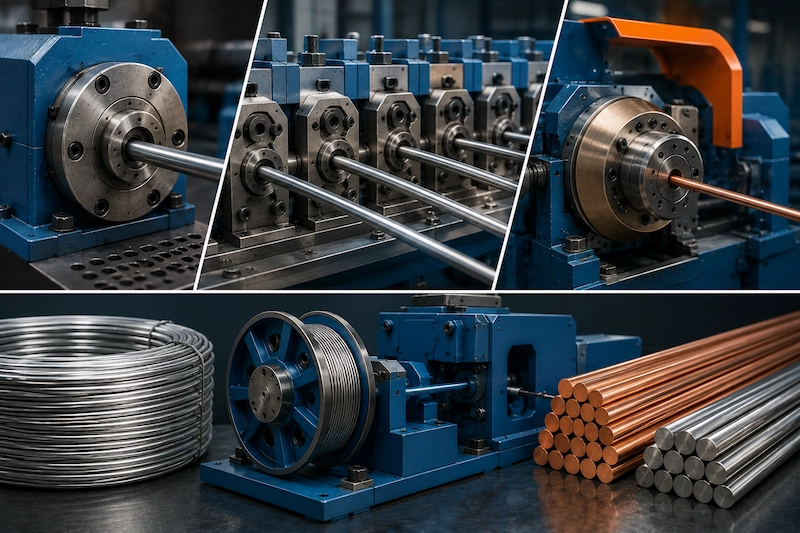
A wire drawing machine can process various metal materials, including:
Low carbon steel wire
High carbon steel wire
Stainless steel wire
Copper wire
Aluminum wire
Alloy wire
The machine configuration, die material, lubrication system, and drawing speed must be adjusted according to the material characteristics.
Compared with conventional wire drawing equipment, automatic systems provide several production advantages.
Automation reduces manual operation requirements and allows continuous production with shorter downtime.
Automatic tension adjustment and monitoring systems help maintain consistent:
Wire diameter
Surface condition
Mechanical properties
Automated feeding and take-up systems reduce dependence on manual handling.
Precise process control minimizes wire breakage and production defects.
Automation reduces operator exposure to high-speed rotating components and heavy wire handling operations.
Selecting the correct equipment depends on production requirements, material characteristics, and final product specifications.
The machine should match the required input and output wire sizes.
Important factors include:
Raw wire diameter
Finished wire diameter
Number of drawing passes required
Manufacturers should evaluate:
Required daily output
Drawing speed
Working hours
Future production expansion plans
Choosing a machine with suitable capacity prevents production bottlenecks.
Automatic systems vary in configuration.
Consider features such as:
Automatic wire feeding
Digital speed control
Automatic tension adjustment
Fault monitoring systems
Automatic take-up
Higher automation levels can improve long-term operational efficiency.
A reliable wire drawing machine should have:
Strong mechanical structure
High-quality transmission components
Efficient cooling system
Easy access for maintenance
Equipment durability directly affects production costs over the machine lifecycle.
Regular maintenance ensures stable performance and extends equipment service life.
Recommended practices include:
Checking drawing dies regularly
Maintaining proper lubrication levels
Inspecting bearings and transmission parts
Monitoring cooling system performance
Cleaning wire feeding components
Replacing worn parts promptly
Preventive maintenance reduces unexpected downtime and improves production reliability.
A standard wire drawing machine performs the basic wire reduction process, while an automatic wire drawing machine includes automated systems for feeding, tension control, monitoring, and wire collection.
Automatic models are designed for higher production efficiency and more consistent operation.
Multiple drawing stages allow gradual diameter reduction while controlling stress and preventing wire breakage.
A single large reduction can damage the wire structure, while multi-pass drawing improves accuracy and product quality.
Key factors include:
Raw material quality
Drawing die condition
Lubrication effectiveness
Machine speed
Cooling performance
Operator maintenance practices
Proper control of these factors improves output quality and reduces operating costs.
The service life depends on machine quality, operating conditions, maintenance frequency, and production intensity. With proper maintenance and regular replacement of wear parts, industrial wire drawing machines can operate reliably for many years.
An automatic wire drawing machine is a key piece of equipment for modern steel wire manufacturing. By combining precision drawing technology with automated control systems, it enables manufacturers to produce high-quality wire with improved efficiency, consistency, and lower operating costs.
Understanding the working process, machine types, and selection factors helps companies choose the right solution for their production requirements. For industries such as nail manufacturing, welding wire production, spring production, and metal processing, reliable steel wire drawing equipment is essential for maintaining competitive production capabilities.
 English