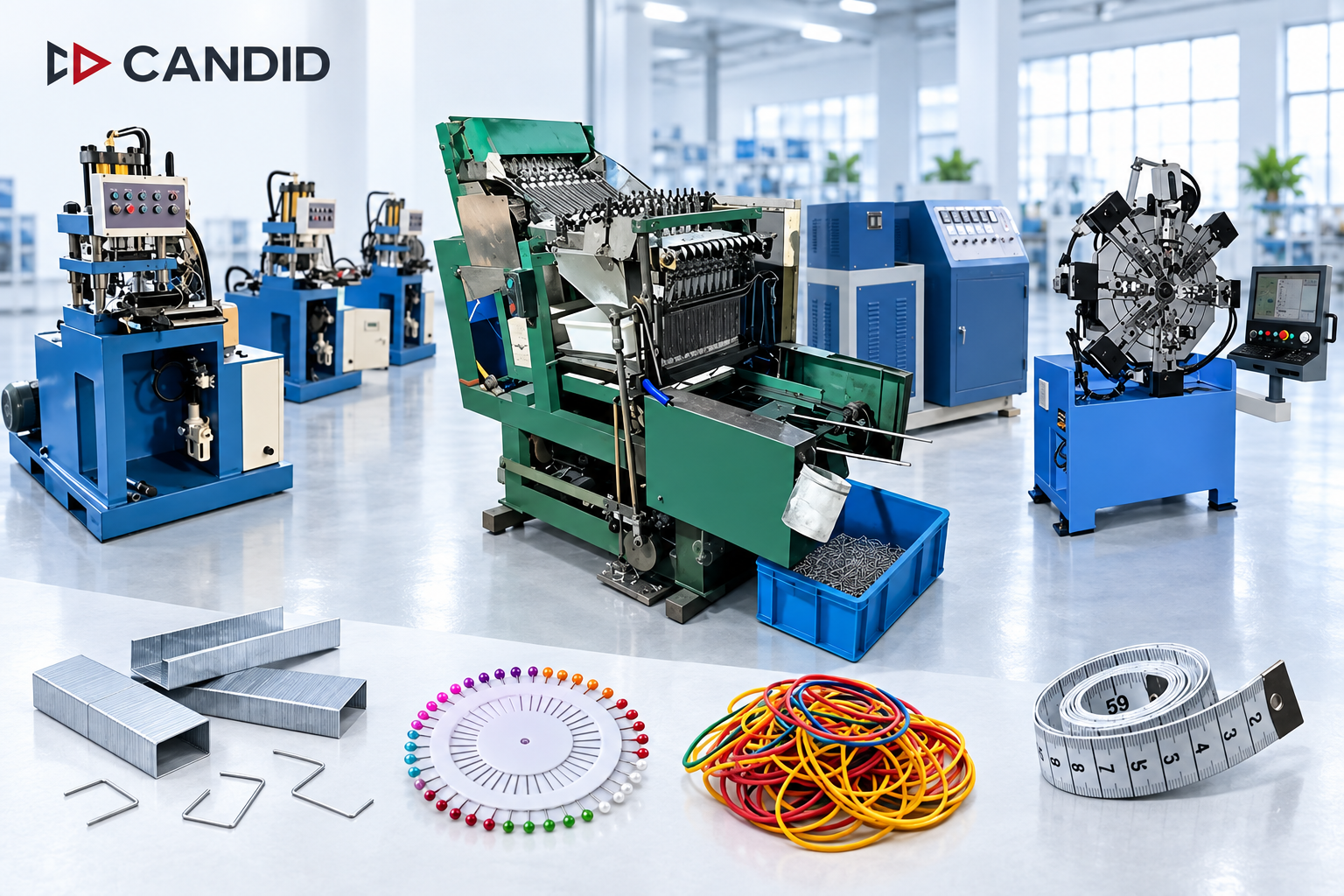
Choosing a stationery making machine starts with a clear definition of the finished product, production target, raw material, quality standard and available factory resources. A suitable machine should deliver the required product dimensions consistently while keeping labor, tooling, power consumption and maintenance within the factory's operating budget.
This guide compares eight practical production solutions for staples, hog rings, paper clips, special wire clips, rubber bands, pearl head pins and fiber measuring tapes. It is intended for stationery manufacturers, new factory investors, wholesalers developing private-label products and distributors planning local production.
CANDID supplies stationery manufacturing machinery and helps buyers configure equipment according to finished samples, raw materials, output requirements and local electrical conditions.
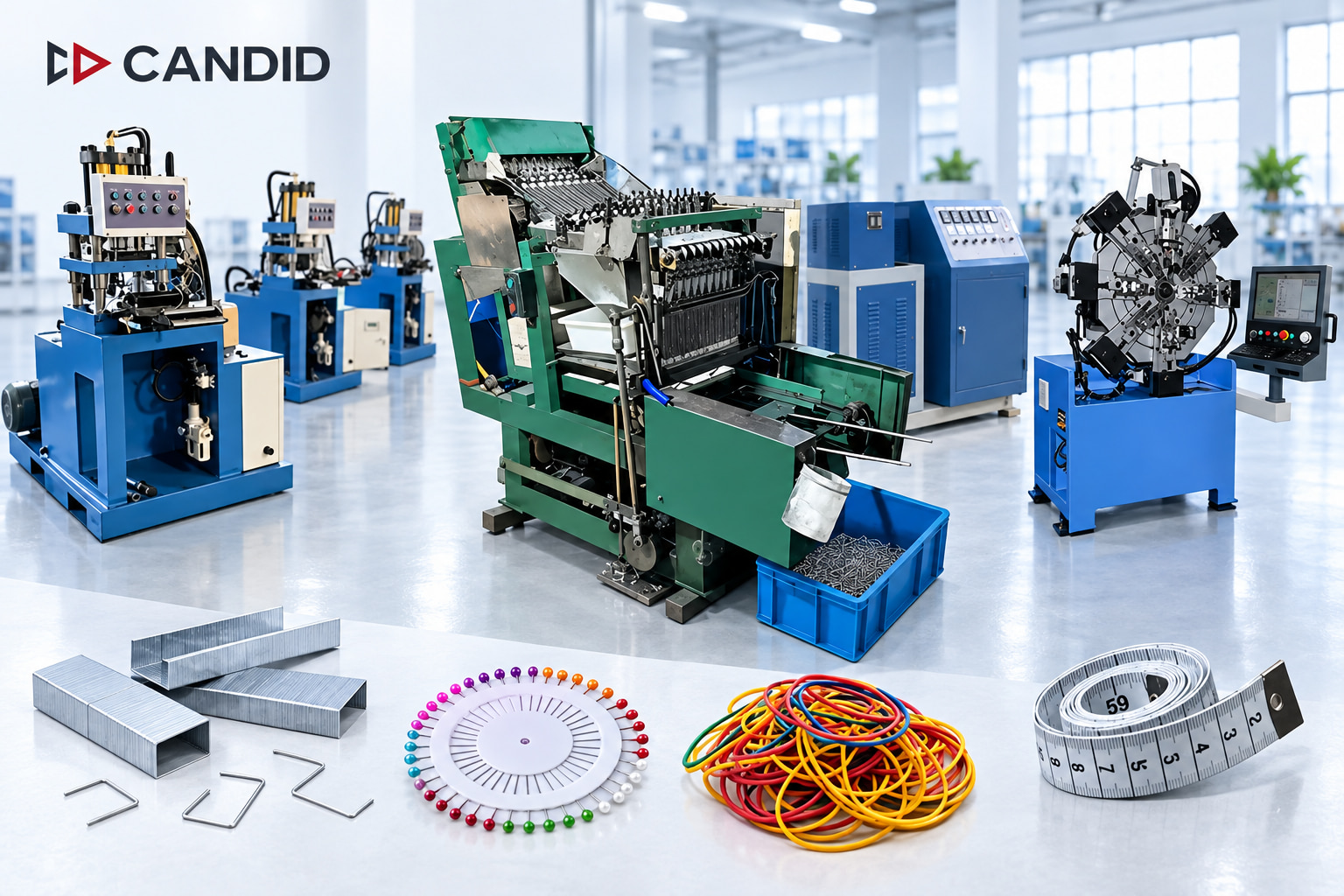
Definition A stationery making machine comparison connects each machine with its finished product, compatible material, reference output and most suitable manufacturing application.
The output figures below are reference values from CANDID's published equipment configurations. Actual production depends on product size, tooling condition, raw-material consistency, operator experience and planned operating time.
Machine | Finished Product | Typical Material | Reference Output | Best Fit |
Staple Production Line | Office and industrial staple strips | Galvanized steel wire with 500-600 MPa tensile strength | Up to 125 strips/min | Continuous higher-volume production |
Single-Wire Staple Machine | Staple strips formed from one wire | Galvanized steel wire, about 0.45-0.70 mm | Up to 350 pieces/min | Smaller workshops and flexible production |
Hog Ring Machine | Hog rings and fastening rings | Galvanized steel wire, about 1.6-3.0 mm | Up to 150 pieces/min | Furniture, bedding, packaging and fencing |
Paper Clip Machine | Standard clips in multiple lengths | Nickel-plated or PVC-coated steel wire | About 150-170 pieces/min | Standardized office supplies |
Special Clip Machine | Custom-shaped wire clips | Nickel-plated or PVC-coated steel wire | Configured to sample | Private-label and differentiated products |
Rubber Band Machine | Elastic bands in different colors and sizes | TPU, TPR, SBS or TPE | Extrusion 35-40 kg/h; cutting 2,000-2,500 pieces/min | Continuous extrusion and high-speed cutting |
Pearl Head Pin Machine | Pearl head pins and decorative pins | Steel pin wire, about 0.6-1.0 mm | Up to 250 pieces/min | Garment, sewing and craft supplies |
Fiber Measuring Tape Machine | Flexible measuring tapes | Fiber substrate, coating and printing ink | Confirmed from sample | Tailoring, garment and promotional products |
Buyer note Pieces per minute, strips per minute and kilograms per hour describe different processes and cannot be compared as equivalent capacity figures.
Definition The best manufacturing application is the product and order structure for which a machine can maintain stable quality, practical output and an acceptable production cost.
A complete staple production line is designed for factories that want to control several stages of metal staple production. A typical configuration combines wire drawing and flattening, wire gluing and staple forming.
The reference forming capacity reaches 125 strips per minute, with approximately 100-260 staple pieces in each strip depending on the product specification. The listed forming-machine motor is 5.5 kW, while the standard electrical reference is 380 V, three-phase and 50 Hz.
The production line supports common sizes such as 10#, 24/6, 26/6 and several 23-series lengths. Around 50 kg of adhesive may be required for one metric ton of wire under the published reference configuration. Buyers should provide actual staple samples because crown width, leg length, wire thickness, strip count and adhesive performance all affect tooling and output.
The single-wire staple making machine forms staples from an individual wire and offers a compact option for workshops entering staple manufacturing. Procurement teams may also describe this equipment as a staple machine or stapler pin making machine.
Its reference capacity reaches 350 pieces per minute, commonly arranged as seven strips of 50 pieces each per minute. The published motor power is 0.75 kW, and the machine weight varies from approximately 150 to 300 kg according to the selected configuration.
This option suits factories with moderate order volumes, several product sizes or limited production space. Reference adhesive consumption is approximately 17 kg per metric ton of wire. The buyer should calculate downstream counting, packing and changeover time before establishing daily output.
A hog ring making machine converts galvanized wire into connected fastening rings used in furniture, bedding, packaging, fencing and related assembly applications.
CANDID's reference model handles wire from approximately 1.6 to 3.0 mm and produces up to 150 pieces per minute. The equipment uses approximately 2.0 kW of total power and requires a working area of about 2 x 2 metres.
Hog rings are commonly connected into strips of around 100 pieces using hot-melt tape. Product geometry, wire hardness, closing performance and compatibility with the customer's fastening tool should be verified from samples before the forming die is approved.
A paper clip making machine straightens and bends coated or plated steel wire into repeatable clip shapes for office, school and packaging markets. Stable wire feeding and tooling alignment are central to consistent paperclip manufacturing.
Available reference models cover finished clip lengths from approximately 22 to 50 mm. Depending on the model and wire diameter, published production speed ranges from 150 to 170 pieces per minute. Common reference wire diameters include 0.80 mm for smaller clips and 1.20 mm for 50 mm clips.
The standard motor reference is 1.1 kW. With organized feeding and collection, one trained operator may supervise two or three machines, subject to the product, factory layout and quality-control method. This arrangement can improve labor productivity for manufacturers receiving stable, repeat orders.
A special clip making machine is configured around a defined wire path and finished geometry to manufacture clips that differ from common office designs. Each clip manufacturing machine should be matched to the intended wire and bend sequence.
This machine is suitable for buyers developing colored clips, shaped promotional clips, private-label office accessories or functional wire forms. Nickel-plated and PVC-coated steel wire are common material options.
The finished sample is especially important for custom clip manufacturing. For a packing clip manufacturing machine, the supplier should evaluate wire diameter, bend radius, forming steps, surface protection and dimensional tolerance before confirming tooling and speed.
A rubber band making machine extrudes an elastic polymer into a continuous tube or profile, cools and pulls the material, and then cuts it into individual bands. A quotation for an automatic rubber band machine should state whether extrusion, cooling, traction and cutting equipment are included.
The CANDID rubber band production machine can process TPU, TPR, SBS and TPE. Its 55 mm single-screw extruder has a length-to-diameter ratio of 28:1 and a reference production rate of 35-40 kg per hour. The downstream rotary cutting machine operates at a listed speed of approximately 2,000-2,500 cuts per minute.
Material formulation has a direct impact on elasticity, recovery, color, surface feel and cutting quality. Buyers should run their intended compound or approve a supplier-prepared sample before final acceptance.
A pearl head pin making machine forms and processes metal pins for sewing, garment, floral and craft applications.
The reference machine supports pin lengths from approximately 16 to 30 mm and wire diameters from 0.6 to 1.0 mm. Its listed capacity reaches 250 pieces per minute, with a 1.1 kW motor and an approximate machine weight of 300 kg.
A complete project may also include head molding, pin arrangement and packaging equipment. Buyers should define point sharpness, shaft straightness, head retention, surface finish and packaging quantity because these factors influence the complete production route.
A fiber measuring tape machine supports the production of flexible measuring tapes used by tailors, garment factories, households and promotional-product suppliers.
The recommended configuration depends on the tape substrate, finished width, unit system, print colors, graduation accuracy and end-fitting design. Buyers should send a physical sample or a complete technical drawing so the printing, cutting and assembly process can be evaluated together.
For this product, readable graduations and dimensional accuracy carry greater commercial importance than machine speed alone. The acceptance plan should include print adhesion, repeated measurement checks and inspection across several points of the tape.
Definition A production route is the ordered sequence of material preparation, forming, joining, finishing, inspection and packing required to convert raw material into a saleable stationery product.
Staples, paper clips, special clips, hog rings and pins begin with controlled metal wire. Incoming inspection should verify diameter, tensile properties, coating quality and surface condition. Wire variation can change bending force, finished dimensions and tool wear even when the machine settings remain unchanged.
The next stages can include straightening, flattening, feeding, forming, gluing, cutting or strip assembly. Their exact sequence depends on the product. Quality checks should cover width, length, symmetry, opening angle, surface damage, strip integrity and the number of pieces in each package.
Rubber-band production starts with a defined polymer formulation and controlled material feeding. The production line then extrudes the material through a precision die, cools it in a water-spray section, pulls the profile at a stable rate and cuts it with a rotary unit.
Extrusion output and cutting speed describe separate parts of the same line. A fast cutter cannot compensate for unstable extrusion, cooling or traction. Finished-product inspection should evaluate width, thickness, cut consistency, elasticity, recovery and break resistance.
Flexible measuring-tape manufacturing requires coordination between substrate preparation, scale printing, curing, cutting and final assembly. The technical route should be confirmed using the buyer's intended tape material and artwork.
A useful approval sample should show the complete graduation pattern, logo, colors, measurement units, tape ends and packaging. This approach allows the equipment supplier and buyer to agree on measurable acceptance criteria before shipment.
Definition Equipment selection is a technical and financial evaluation that matches saleable output, product quality, operating safety and total ownership cost with the factory's business plan.
Rated output represents machine speed under defined operating conditions. Production planning should also include setup, material loading, changeovers, inspection, maintenance and unplanned stops.
For example, a paper clip machine rated at 170 pieces per minute has a theoretical eight-hour output of 81,600 pieces.
170 pieces/min x 60 min x 8 hours = 81,600 pieces
At an assumed 75% operating utilization, the planning output becomes approximately 61,200 pieces per shift. This is a planning calculation instead of a guaranteed production figure.
A rubber-band extrusion line rated at 35-40 kg per hour would produce approximately 210-240 kg during an eight-hour shift at the same assumed 75% utilization. Material formulation, product dimensions, cooling conditions and scrap rate can change the actual result.
A useful request for quotation should include a finished sample or drawing, exact dimensions, raw material, coating, required output, package quantity, local voltage and preferred level of automation. For custom products, the buyer should also state critical tolerances and the intended use.
Sample-based confirmation reduces uncertainty because similar-looking products may require different wire diameters, forming dies, feeding systems or cutting tools. It also gives both parties a clear basis for a factory acceptance test.
Quality inspection should focus on characteristics that affect use and customer acceptance. These may include dimensional consistency, surface condition, fastening strength, elasticity, print accuracy, piece count and package integrity.
The ISO 9001 quality management framework provides a useful reference for process control, documented responsibilities and continual improvement. Buyers can also use ISO 2859-1 sampling procedures when developing an acceptance-quality-limit plan for lot-by-lot inspection.
The purchase contract should define the approved sample, inspection tools, sampling method, acceptable tolerance and response to nonconforming output. These details make final acceptance more objective.
Wire feeding, forming dies, cutters, rotating shafts, heated extrusion sections and electrical systems create different operating risks. The final machine layout should provide suitable guarding, emergency stops, operating instructions and safe maintenance access.
The buyer can review the general machine-guarding principles in OSHA Standard 1910.212. Local regulations and factory safety requirements should also be confirmed before installation and commissioning.
The purchase price represents one part of the investment. A practical comparison includes the machine, forming dies, auxiliary equipment, freight, import charges, installation, electrical preparation, air or cooling requirements, spare parts, raw-material trials and working capital.
Product changeover time also affects cost. A flexible machine can be commercially attractive for varied orders, while a dedicated line may offer stronger efficiency for stable, high-volume production. The preferred solution depends on the expected order mix.
Definition A successful stationery production line is an equipment configuration developed from the finished-product specification, validated raw material, realistic capacity target and measurable acceptance standard.
For standardized, high-volume products, a complete production line can provide coordinated output and process control. For developing markets, custom orders or moderate volumes, compact single machines may offer greater operational flexibility.
Before purchasing, prepare finished samples, drawings, material information, target shift output, package requirements and local power conditions. Then compare supplier proposals using saleable output, tooling scope, factory space, energy needs, quality controls and after-sales support.
CANDID can review product samples and help configure machinery, tooling and auxiliary equipment for different production goals. Buyers can learn more about the company's engineering and after-sales services or request a customized production-line proposal.
A detailed inquiry gives the engineering team enough information to recommend an appropriate machine and prepare a more accurate commercial quotation.
Definition These frequently asked questions explain the product, capacity, material, customization and purchasing information buyers commonly need before selecting stationery manufacturing equipment.
Send the finished product sample or drawing, dimensions, raw material, coating or color, target output, package quantity and local voltage. For a custom product, identify the dimensions and performance characteristics that require strict control.
Some machines can support additional sizes through compatible tooling and setup changes. A significantly different shape may require another forming system or a dedicated machine, so every product drawing should be evaluated before the order is confirmed.
A complete line is suitable for continuous production and larger order volumes. A single-wire machine is compact and can suit smaller factories, developing markets and production plans that emphasize flexible capacity.
Multiply rated speed by planned operating minutes and then apply a realistic utilization factor. Include setup, material loading, inspection, changeovers, maintenance and expected scrap when calculating saleable daily output.
Wire-forming machines commonly process galvanized, nickel-plated or PVC-coated steel wire. Rubber-band equipment can process materials such as TPU, TPR, SBS and TPE, while fiber measuring-tape production requires a suitable flexible substrate, coating and printing system.
Agree on a factory acceptance test using the approved raw material and finished-product sample. Record continuous running time, output, dimensional results, scrap rate, surface quality, safety functions and package count, then retain samples and inspection records for comparison after installation.
 English