In the wire mesh manufacturing industry, the weaving and welding processes often get the most attention. However, seasoned production managers know the real bottleneck usually occurs at the finishing stage: trimming the edges.
When producing cable trays, storage cages, or industrial fencing, leaving sharp, uneven edges is not an option. This leads to a critical decision for factory owners: Should you rely on manual labor with hand tools, or invest in a specialized wire mesh trimming machine?
While manual trimming has low upfront costs, the hidden costs of inefficiency and injury can be staggering. In this guide, we compare manual vs. automatic trimming methods to help you decide which is best for your production goals.
For small workshops or custom, one-off projects, manual trimming is the traditional standard. This usually involves workers using angle grinders, handheld hydraulic shears, or bolt cutters to remove excess wire ends.
Low Initial Investment: No capital expenditure is required for machinery.
Flexibility: Human workers can easily adapt to odd shapes or non-standard mesh sizes without machine setup time.
Inconsistent Quality: Even skilled workers cannot cut every wire at the exact same length. This results in uneven edges and sharp burrs that require secondary grinding.
Safety Hazards: Repetitive strain injuries (RSI) and accidents with cutting tools are common safety risks.
Production Bottlenecks: Manual cutting is slow. A high-speed welding machine can produce mesh faster than a team of humans can trim it, creating a backlog on the floor.
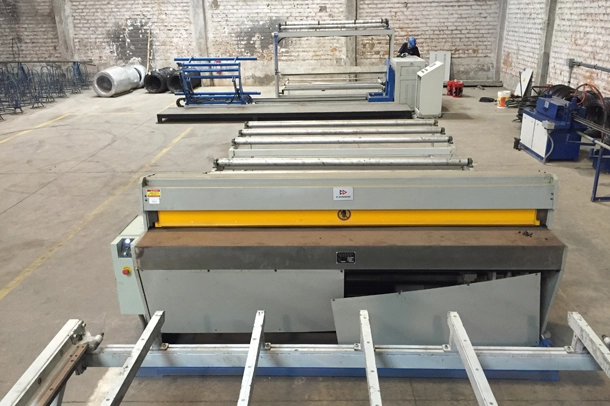
As production volumes increase, automation becomes a necessity. An automatic wire mesh trimming machine is designed to trim the raw edges of welded wire mesh panels or rolls in a single, continuous pass.
These machines utilize hydraulic or mechanical driving systems to deliver high-precision cuts, ensuring the cross-wire ends are smooth and uniform.
(Looking to upgrade your line? View our high-speed Mesh Cutting Machine specifications.)
High Efficiency: An automatic machine can trim a standard mesh panel in seconds—a task that might take a worker several minutes.
Superior Quality: The machine ensures that every wire overhang is cut to the exact same length, often eliminating the need for deburring.
Reduced Labor Costs: One machine operator can replace a team of 4-5 manual trimmers, significantly lowering your long-term overhead.
To help you calculate the ROI (Return on Investment), let’s break down the differences across three key metrics.
Manual trimming is linear; a worker cuts one wire at a time. If a mesh panel has 50 cross wires, that is 50 separate actions. In contrast, a wire mesh trimming machine often employs a wide blade or rapid-fire cutting heads that process the entire edge as the mesh feeds through. For mass production (like cable trays), automation can increase throughput by 300% to 500%.
Quality control is a major challenge in B2B exports. Buyers will reject pallets of wire mesh if the edges are sharp or irregular.
Manual: High risk of "burrs" (sharp leftovers) that can injure end-users.
Automatic: Delivers a clean, flush cut. Modern machines are also enclosed, keeping operators safe from flying metal debris.
While the upfront cost of a machine is higher, the "Cost Per Unit" drops dramatically over time.
Scenario: If you pay three workers to trim mesh all day, their annual salary likely exceeds the cost of one machine. By switching to an automatic mesh trimmer, you achieve ROI typically within 6 to 12 months depending on volume.
Not every shop needs a machine. However, if your production meets any of the following criteria, it is time to upgrade:
Volume: You are processing more than 100 panels per day.
Standards: Your clients require "burr-free" or precision-dimensioned edges.
Labor Shortage: You are struggling to hire or retain workers for difficult manual labor.
Manual trimming has its place in low-volume, custom repair work. But for modern manufacturing lines focused on speed, safety, and export-quality standards, the wire mesh trimming machine is the clear winner. It transforms the trimming process from a production bottleneck into a competitive advantage.
Ready to boost your efficiency?Stop letting manual labor slow down your output. Explore our advanced Wire Mesh Trimming Machine solutions today to find the perfect model for your factory.
 English