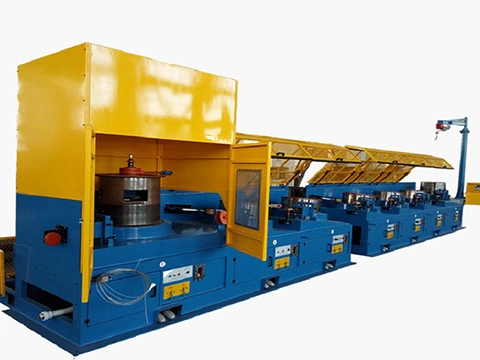
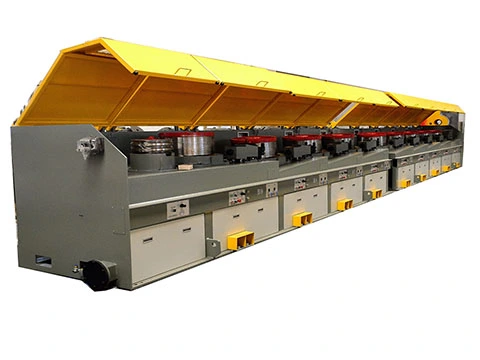
When new investors enter the gabion manufacturing industry, they often focus 100% of their attention on the machine's specifications and completely overlook factory floor organization.
A heavy-duty gabion machine is a massive piece of industrial equipment. If your factory layout forces forklift drivers to navigate tight corners, or if your overhead crane cannot easily reach the wire pay-offs, your material handling times will skyrocket. Poor layout directly translates to machine downtime and lost profits.
At Candid Equipments, we don't just supply the machinery; we help you build an efficient production ecosystem. Here is our expert guide on the optimal linear layout for a gabion production floor, including footprint requirements and crucial clearance zones.
To minimize material handling, your production line must follow a strict linear path. The raw material (steel wire) enters at one end, and the finished, packed gabions exit at the other. No bottlenecks, no backtracking.
Here is the exact sequence you need to plan for:
The Setup: This is where your massive wire spools sit. You will need a wide, open area directly behind the main machine.
Handling Requirement: This area must be easily accessible by an overhead bridge crane or a heavy-duty forklift. You will be constantly swapping out heavy steel wire coils.
Pro Tip: Leave at least 2 to 3 meters of clearance behind the pay-offs for safe forklift maneuvering and raw material staging.
The Setup: The wire feeds directly from the pay-offs into the main gabion weaving machine.
Handling Requirement: Operators need walking space (at least 1.5 meters) on both the left and right sides of the machine for monitoring the twisting pinions, changing molds, and performing weekly lubrication.
The Setup: Located immediately after the weaving zone, this heavy roller system pulls the woven mesh forward evenly.
Handling Requirement: Keep the path between the main machine and the tensioner completely clear of debris or tools, as operators will need to walk this line frequently during setup.
The Setup: The tensioner feeds the continuous mesh into the CNC auto-cutter, which shears the mesh into pre-set lengths.
Handling Requirement: You need an extended run-out table or an automated conveyor after the cutter to support the large, flat sheets of mesh before they are moved.
The Setup: The cut sheets are moved (either manually or via conveyor) into the hydraulic press to be compressed and strapped into tight bundles for shipping.
Handling Requirement: This is your finished goods exit. It must have direct, straight-line access to your warehouse loading dock. A forklift must be able to drive right up to the packer, pick up the heavy bundle, and drive away without reversing through tight spaces.
Before you pour concrete or sign a lease, ensure your building meets these physical requirements:
Total Linear Footprint: A fully automated line (from pay-offs to packer) typically requires a minimum straight-line length of 25 to 35 meters (82 to 115 feet), depending on your specific machine model.
Overhead Crane Clearance: This is the most common mistake. Your factory ceiling must be high enough to accommodate an overhead crane lifting a heavy wire spool over the payoff stands. We recommend a minimum hook height of 5 to 6 meters (16 to 20 feet) in the raw material zone.
Power & Trenching: Plan for under-floor cable trenches running alongside the machine. You do not want thick power cables creating tripping hazards on the walking paths.
Organizing a heavy machinery floor is complex, but the right equipment partner makes it easier.
AtCandid Equipments, our gabion machines are designed with modularity in mind. When you partner with us, we provide detailed technical drawings, footprint dimensions, and foundation plans to ensure your factory is perfectly prepared before the machine even arrives at your port.
Stop guessing your floor plan. Explore our highly efficient, space-optimized gabion lines in our [Products Catalog / Gabion Machine Section] .
 English