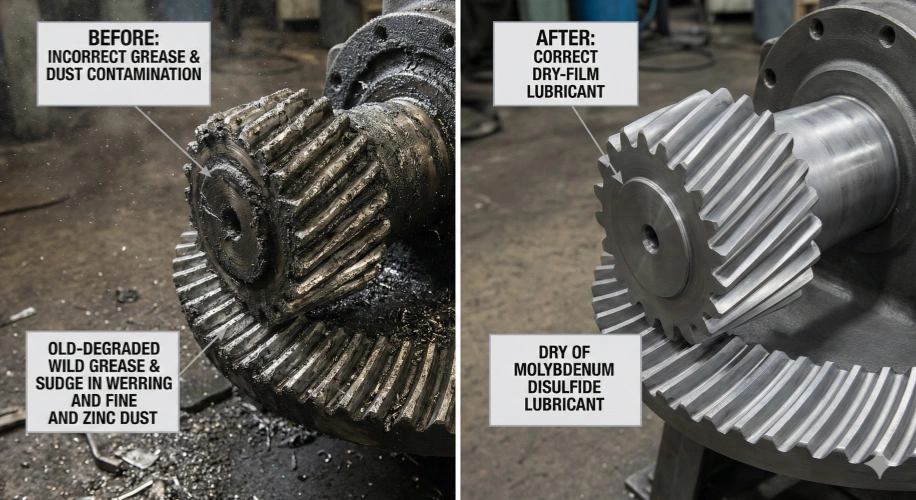
If you consult a generic machinery manual, the maintenance section usually offers one simple piece of advice: "Lubricate the main driving gears weekly." For operators of heavy-duty gabion machines, following this generic advice is a guaranteed way to destroy your driving gears. Why? Because a gabion mesh factory is not a cleanroom. The production of heavy galvanized wire mesh generates a constant cloud of zinc dust, steel shavings, and industrial dirt. When you apply standard liquid oil or basic grease to your open gears in this environment, the lubricant acts like a magnet. It traps the metallic dust, transforming your expensive gear oil into a highly abrasive grinding paste that eats away at the gear teeth.
At Candid Equipments, we design machinery for real-world factory conditions. Here is our expert guide on the optimal oil viscosity, the right type of grease, and the exact schedule required to protect your gabion machine's gears from dust degradation.
You need different lubricants for your enclosed gearboxes versus your exposed driving gears.
Never use standard multi-purpose grease (like basic lithium grease) on the open twisting gears. It is too sticky and will immediately collect zinc dust.
The Solution: Use an Open Gear Lubricant (OGL) with high viscosity and tackifiers, specifically formulated with solid lubricants like Molybdenum Disulfide (MoS2) or Graphite.
Alternative (For Extremely Dusty Environments): Consider a Dry-Film Lubricant. These spray-on lubricants go on wet but dry to a hard, slick finish. Because they leave no sticky residue behind, zinc dust and steel shavings bounce right off the gears instead of sticking to them.
Since enclosed gearboxes are protected from the airborne zinc dust, you must focus on extreme pressure (EP) resistance due to the heavy loads of gabion production.
The Optimal Viscosity: Use a high-viscosity industrial gear oil, typically ISO VG 320 or ISO VG 460 with EP additives. This thickness maintains a strong oil film even when the machine is pulling thick, high-tensile steel wires.
The biggest mistake operators make is pumping new grease directly on top of old, dust-contaminated grease. This just pushes the abrasive zinc particles deeper into the gear meshing zones.
Before applying any new lubricant to open gears, you must remove the old layer. Use a biodegradable industrial degreaser and stiff nylon brushes (never wire brushes, which can damage the metal) to clear away the hardened, contaminated sludge.
Throw away the "lubricate weekly" rule. In a heavy-duty gabion facility running 8-hour or 12-hour shifts, you need a proactive schedule:
Daily (End of Shift): * Action: Use compressed air to blow away loose zinc dust and steel shavings from the main driving gears and wire feed zones. Do not apply new grease.
Weekly (Every 40-50 Hours of Operation):
Action: Inspect the open gears. If the grease looks black, gritty, or dry, it's time to act. Wipe down the gears to remove the worst of the contaminated surface layer. Apply a light, fresh coating of your chosen Open Gear Lubricant or Dry-Film spray. Check the oil level in your enclosed gearboxes.
Monthly (Every 200 Hours of Operation):
Action: Perform a deep clean. Completely degrease the main twisting gears and racks. Inspect for uneven wear patterns. Reapply a thorough, even coat of high-grade OGL.
Maintenance in a dusty environment is inevitable, but poorly designed machines make it a nightmare.
At, our heavy-duty gabion mesh machines are engineered to minimize contamination risks. We utilize robust, precision-machined enclosed gearboxes wherever possible to isolate critical moving parts from airborne zinc dust. For our exposed twisting mechanisms, we design accessible, easy-to-clean gear racks that cut your weekly maintenance time in half.
Stop letting dust destroy your production line. Invest in machinery built for the reality of your factory floor.
Explore our durable, low-maintenance gabion machines .
 English