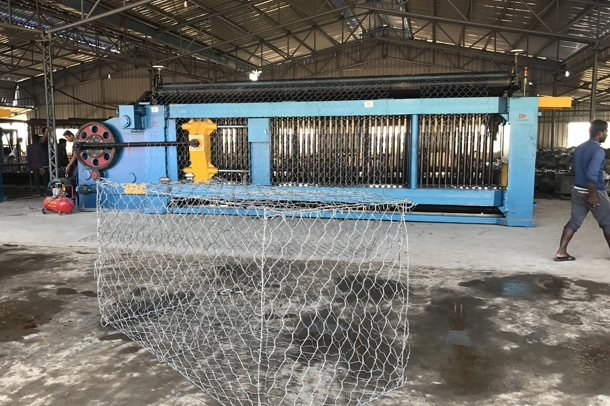
You are running your gabion mesh machine smoothly with standard galvanized wire, but the moment you switch to PVC-coated wire, production grinds to a halt. The inner steel core snaps, or the tensioner rollers completely strip the soft PVC coating, leaving bare, unprotected metal exposed.
If you check your manufacturer's manual, you will likely find a frustratingly vague instruction: "Adjust the tension." But how? PVC-coated wire has a much softer surface and a thicker overall diameter than bare galvanized wire. Applying the same mechanical tension will immediately cause surface damage or wire breakage. In this guide, we will walk you through the exact mechanical adjustments needed on your tensioner rollers to transition seamlessly between wire types.
Before adjusting your machine, it is crucial to understand why the wire is snapping or stripping:
Surface Friction: Galvanized steel has a hard surface that can withstand high-pressure clamping from V-groove rollers. PVC coating is soft and grips the rollers, increasing friction and heat.
Diameter Differences: A 2.7mm galvanized wire might become 3.7mm after PVC coating. If you force a 3.7mm wire through a tension setting meant for 2.7mm, the rollers will crush the plastic layer.
Core Elongation: The steel core inside the PVC still dictates the breaking point. If the PVC grips the rollers too tightly while the machine pulls, the steel core inside stretches and snaps.
To prevent stripping and snapping, you need to transition from a high-pressure/low-contact setup to a low-pressure/high-contact setup. Here is how to mechanically calibrate your gabion machine:
Never try to just "loosen" the current setting slightly. When switching from galvanized to PVC, completely release the pressure springs on all wire straightening and tensioning rollers. Feed the PVC wire through the system while it is completely loose.
Check the profile of your tensioner rollers:
For Galvanized Wire: V-groove rollers are often used because they bite into the hard metal to keep it straight.
For PVC Wire: You must use U-groove rollers. V-grooves will slice right through the plastic coating. Ensure the U-groove radius matches the outer diameter of your PVC wire, not the inner steel core.
Tension does not just come from the machine's feed rollers; it starts at the wire pay-off stand.
Reduce the braking friction on the pay-off stand by about 20% to 30% compared to your galvanized setting.
The spool should spin freely enough to prevent the wire from stretching before it even reaches the machine, but tight enough to prevent over-spooling.
Instead of clamping down the tensioner rollers tightly, adjust the spring-loaded nuts gradually.
Tighten the rollers just enough so that they make full contact with the PVC coating.
The Test: Try to manually pull the wire backward against the feed direction. If you can slide it with heavy resistance, the tension is correct. If the wire doesn't budge at all, the rollers are too tight and will strip the coating during high-speed operation.
Inspect the ceramic or steel entry guides where the wire first enters the machine. Burrs or sharp edges left from running kilometers of hard galvanized wire will act like a razor blade on soft PVC. Polish or replace worn guides before feeding PVC wire.
Problem: The PVC coating is bunching up (accordion effect) before the weaving gear.
Solution: The feed rollers are pushing faster than the weaving gear is pulling, AND the roller pressure is too high. Decrease the clamping pressure on the primary feed rollers.
Problem: The wire is snapping entirely.
Solution: Check the pay-off stand brake. If the wire is caught or the brake is too tight, the pulling force of the main machine will snap the steel core.
Transitioning between wire types shouldn't cause hours of downtime. At Candid (China Equipments), our state-of-the-art gabion machines are engineered with precision-adjustable tensioning systems and quick-swap roller designs, making it effortless to switch from heavy-duty galvanized wire to PVC-coated wire without damaging the material.
Explore our full range of wire mesh machinery at Candid Equipments or visit our main portal at China Equipments to find the right solution for your production line.
 English